Why Self-Care Alone Isn't Enough: An Anti-Oppressive Approach to Wellbeing
What if the problem isn't that you're failing at self-care?
What if you're being asked to cope with more than anyone reasonably should?
We are surrounded by advice on how to improve our wellbeing.
Sleep more.
Drink more water.
Practise mindfulness.
Journal.
Exercise.
Set better boundaries.
Take time for yourself.
There is nothing inherently wrong with this advice. In fact, many of these practices can genuinely support our wellbeing.
Rest, reflection, movement and healthy boundaries all have an important place in caring for ourselves.
But what happens when self-care becomes the answer to everything?
What happens when we begin to believe that if we are struggling, it must be because we haven't tried hard enough?
This is where I believe we need a broader conversation.
Wellbeing doesn't happen in a vacuum
We often speak about wellbeing as though it is entirely our individual responsibility.
If only we had a better routine.
If only we were more resilient.
If only we managed our stress more effectively.
Yet our wellbeing is shaped by far more than our personal habits.
It is influenced by our relationships.
Our identities.
Our communities.
Our opportunities.
Our financial security.
Our sense of belonging.
The discrimination we may experience.
The systems we navigate every day.
The resources available to us.
The environments in which we live and work.
None of us exists in isolation.
Our wellbeing doesn't either.
From self-blame to self-compassion
One question has become increasingly important in my work:
Instead of asking,
"Why can't I cope?"
What if we asked,
"What am I being asked to cope with?"
It is a subtle shift in language.
But it can completely change how we understand ourselves.
The first question often assumes the problem lies within us.
The second invites us to consider context.
Perhaps you are caring for ageing parents while raising children.
Perhaps you are navigating discrimination at work.
Perhaps you are living with chronic uncertainty.
Perhaps you are experiencing financial pressure.
Perhaps you are constantly adapting parts of yourself in order to belong.
Perhaps you are carrying responsibilities that nobody else can see.
When we ask what we are being asked to cope with, we begin to replace judgement with curiosity.
And curiosity often creates space for compassion.
Self-care matters—but it cannot solve everything
I believe deeply in self-care.
I encourage people to rest.
To establish boundaries.
To nurture supportive relationships.
To notice their needs.
To seek help.
To create moments of joy.
But self-care has limits.
A morning routine cannot remove discrimination.
Meditation cannot create financial security.
Gratitude cannot replace psychological safety.
Better boundaries cannot change an unhealthy organisational culture.
Sometimes the conditions around us genuinely need to change.
Recognising this does not diminish the value of self-care.
It simply reminds us that wellbeing is both personal and collective.
An anti-oppressive approach to wellbeing
An anti-oppressive approach asks us to widen the conversation.
Rather than viewing wellbeing solely through an individual lens, it encourages us to consider the wider factors shaping people's lives.
Identity matters.
Power matters.
Relationships matter.
Belonging matters.
Culture matters.
Faith may matter.
Social and economic realities matter.
This does not mean we abandon personal responsibility.
It means we recognise that personal responsibility exists within social realities.
We can care for ourselves while also acknowledging that some burdens should never have been ours to carry alone.
Identity is the foundation of wellbeing
One of the ideas that underpins all of my work is this:
We cannot fully understand wellbeing without understanding identity.
Identity shapes how we see ourselves.
How others see us.
Where we feel we belong.
The opportunities we are offered.
The assumptions made about us.
The support we receive.
The barriers we encounter.
When we overlook identity, we risk offering wellbeing advice that feels disconnected from people's lived experiences.
When we begin with identity, wellbeing becomes more compassionate, more culturally attuned and more meaningful.
A different conversation
Perhaps the goal is not to stop talking about self-care.
Perhaps it is to place self-care within a bigger conversation.
One that includes relationships.
Communities.
Systems.
Belonging.
Justice.
Identity.
Because wellbeing is never simply about becoming better at coping.
Sometimes it is about recognising what we have been expected to cope with in the first place.
A question to reflect on
The next time you find yourself thinking,
"Why can't I cope?"
Pause for a moment.
And instead ask,
"What am I being asked to cope with?"
You may find that the answer opens the door not only to greater understanding—but also to greater self-compassion.
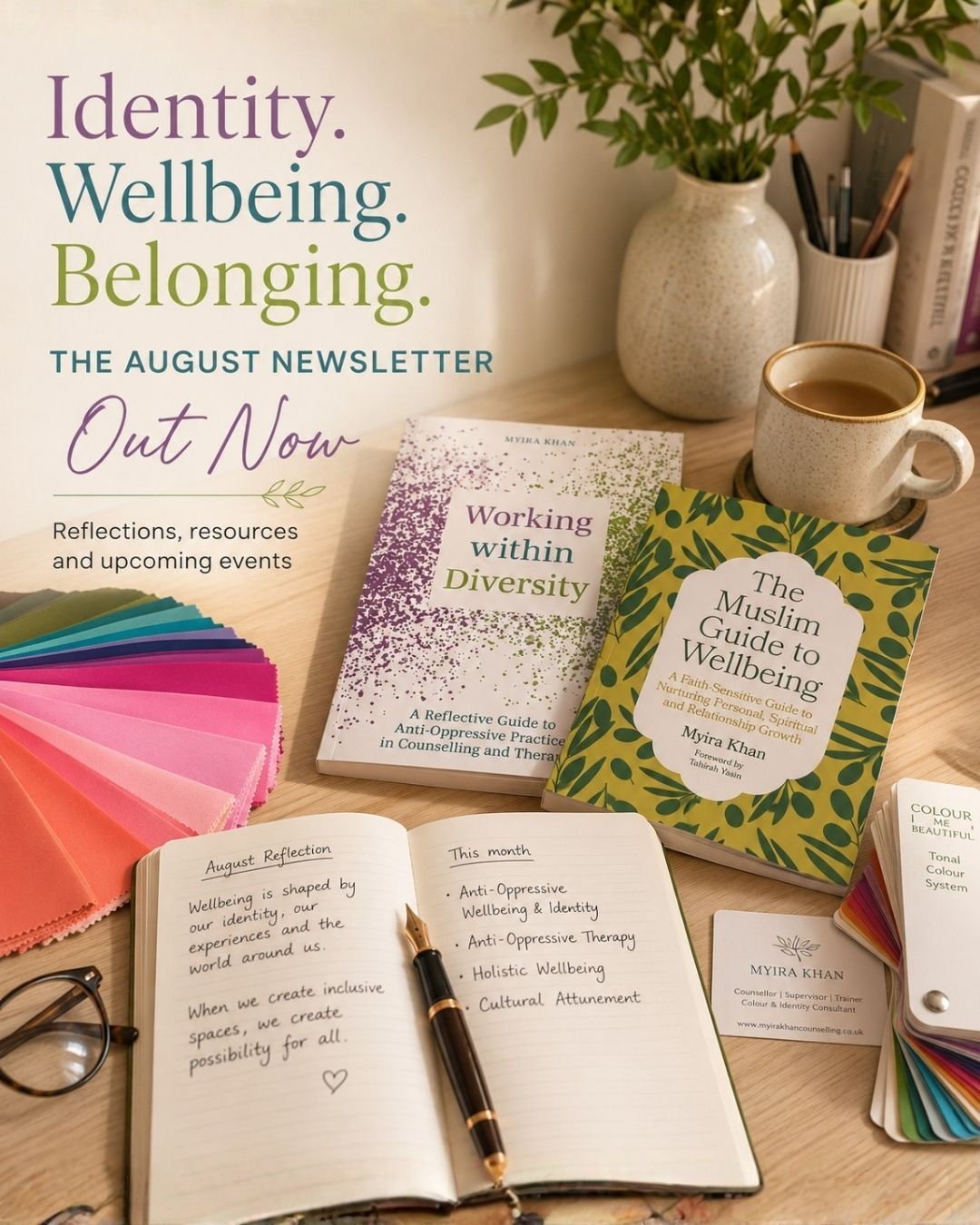
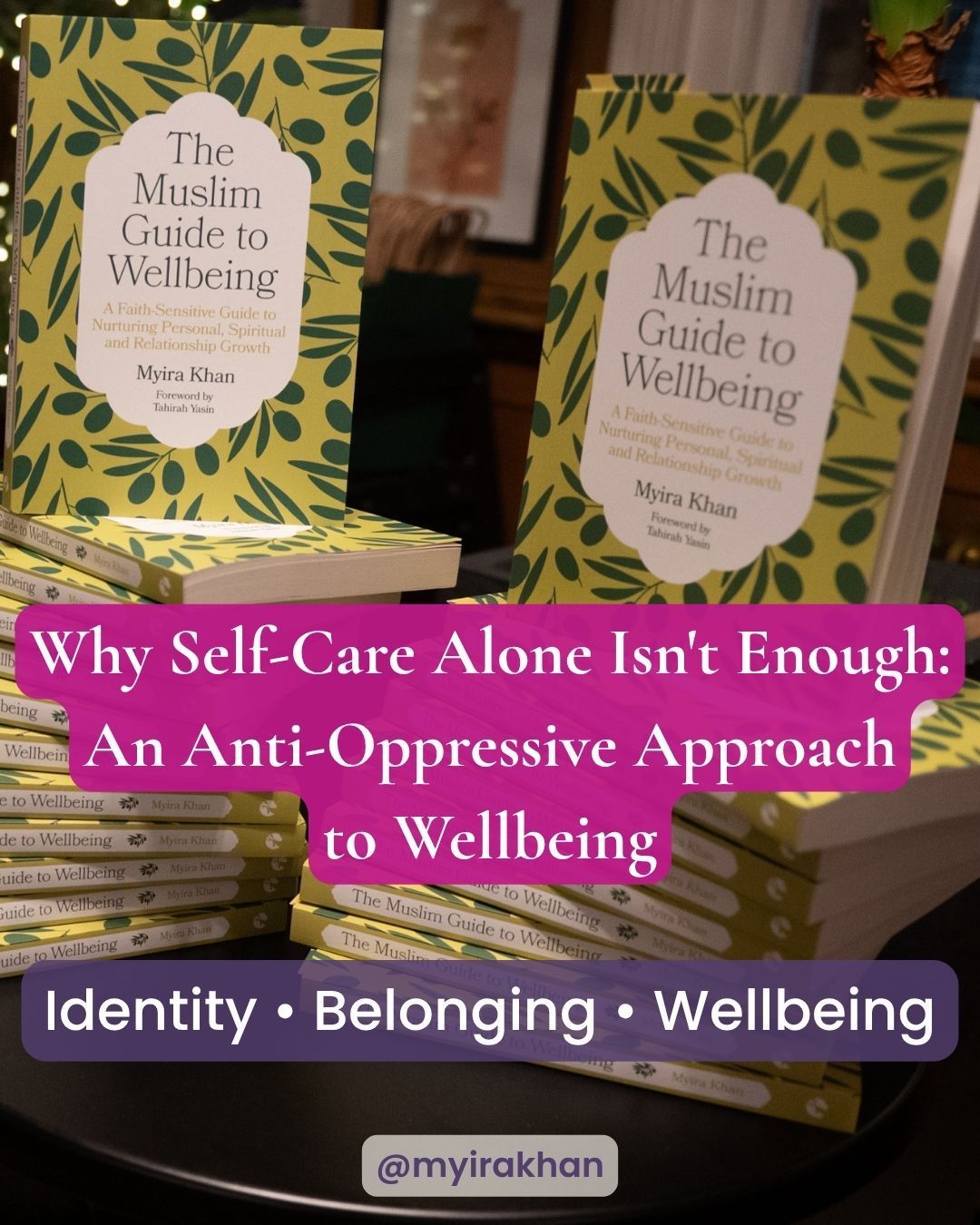
If these ideas resonate with you, you'll find more reflections on identity, belonging and holistic wellbeing throughout this blog, in my book The Muslim Guide to Wellbeing, and across my training, speaking and counselling work.